Pastor Tony's Sermon July 23, 2017

Matthew 18: 21-35     7-23-17      Rev. Tony Clark     ACCUCC

Listen to this week's sermon by clicking here.

At that point Peter got up the nerve to ask, “Master, how many times do I forgive a brother or sister who hurts me? Seven?”

Jesus replied, “Seven! Hardly. Try seventy times seven. 

“The kingdom of God is like a king who decided to square accounts with his servants. As he got under way, one servant was brought before him who had run up a debt of a hundred thousand dollars. He couldn’t pay up, so the king ordered the man, along with his wife, children, and goods, to be auctioned off at the slave market.

“The poor wretch threw himself at the king’s feet and begged, ‘Give me a chance and I’ll pay it all back.’ Touched by his plea, the king let him off, erasing the debt.

“The servant was no sooner out of the room when he came upon one of his fellow servants who owed him ten dollars. He seized him by the throat and demanded, ‘Pay up. Now!’

“The poor wretch threw himself down and begged, ‘Give me a chance and I’ll pay it all back.’ But he wouldn’t do it. He had him arrested and put in jail until the debt was paid. When the other servants saw this going on, they were outraged and brought a detailed report to the king.

“The king summoned the man and said, ‘You evil servant! I forgave your entire debt when you begged me for mercy. Shouldn’t you be compelled to be merciful to your fellow servant who asked for mercy?’ The king was furious and put the screws to the man until he paid back his entire debt. And that’s exactly what my Father in heaven is going to do to each one of you who doesn’t forgive unconditionally anyone who asks for mercy.’


Every week we pray the Lord’s Prayer, saying, “Forgive us our debts, as we forgive our debtors.” Other churches say every week, “forgive us our sins as we forgive those who sin against us,” or “forgive us our trespasses, we forgive those who trespass against us.” Over the last few weeks, you may have noticed that I have been saying trespasses rather than debts, and I have done this purposely because it reminds me that it’s not so much the financial debts that I need to have forgiven, but the actions that I have done or have left undone that harmed someone else.

I must confess, though, that every time I say “Forgive us our trespasses,” I think immediately of Winnie-the-Pooh’s best friend Piglet, whose house had a sign in front that said, “Trespassers W--” with the rest of the sign broken off. Of course, the sign was short for “Trespassers will be shot,” or “Trespassers will be prosecuted,” or maybe “Trespassers will be asked in for tea and crumpets.” But Piglet declared that it was for his grandfather, who was called, “Trespassers William.”

Forgive me God, for trespassing on such a serious topic as forgiveness with my impertinent humor. Teach us, O Great Forgiver, how to forgive—one another, ourselves, and even you. May the words…

Here we are at the Sunday of Forgiveness.

Last week we heard from Dorothy what forgiveness is not—it is not forgetting, it is not reconciliation or renewal of relationship, it is not a free pass out of punishment nor a release from the effects of acting badly. Forgiveness is not immediate, nor is it a miracle. Forgiveness is not for the offender.

“Forgiveness is,” as Papa says to Mack, “first for you, the forgiver, to release you from something that will eat you alive; that will destroy your joy and your ability to love fully and openly…. When you choose to forgive another, you love him well.”[1]

So, if forgiveness is for the forgiver, why do we ask God to forgive us every week? If we believe God is first and foremost all-loving, then God has already forgiven us before we even ask. And yet, the asking is important. The asking itself acknowledges our wrong doing, our sin and separation from God, our trespassing on another’s property or crossing another’s emotional boundaries. Saying “I’m sorry” is an important thing in relationships.

We say, “forgive my sins, God; forgive me for those times when I became angry at you for not giving me what I wanted, and then turned my back on you. I know you did not leave me. I wanted, wished, hoped for something so badly, that it became a need, an expectation that I demanded that you fulfill, and when you didn’t, I pouted, I stomped my feet, I slammed my bedroom door and said, ‘I hate you!’ Forgive me, God.”

At that moment of yelling and door slamming, don’t we humans expect God to react the way an angry parent might, marching up to the door, pounding on it and saying, “Listen here, you ungrateful brat…,” and grounding us for the rest of our natural born lives? At that moment, it takes everything for even a good human parent to remain calm and loving.

Yet God is not human, and God doesn’t react that way. God responds with love, with immediate forgiveness. So perhaps asking for forgiveness from God is really a way to say, “I’m sorry,” acknowledging or admitting something we did wrong to ourselves and God, and expecting wrath, we ask God to forgive, which we intuit will release the anger, the wrath, the rage we know comes from humans who are broken and hurting.

And so we ask for forgiveness. Still, asking someone else for forgiveness does not guarantee they will forgive us; that action is theirs to take, not ours to demand. We cannot demand that God forgive us; we can only say, “I’m sorry, and I hope you find it in yourself to forgive me. Not because I need your forgiveness, but because you need to forgive, to let it go, to release the anger, the pain, the suffering I caused, so that you can become more whole.”

However, God is already whole, God is loving, God has already forgiven even before we ask. So why do we ask God week in and week out to forgive our debts, or our sins, or our trespasses?

I think it is really a plea to our inner self to forgive our own actions. Can I forgive my own debts, my own sins, my own trespasses?

Forgive me God, I am sorry for slamming the door between us. And then, O God, empower me to forgive my own debts, my own sins, my own trespasses--those times when I crossed a boundary I didn’t know was there, or a line I knew was there but crossed it anyway in defiance. Give me the fortitude to face and acknowledge the times when have I stepped on someone else’s toes either literally or metaphorically.

I said a few weeks ago that I get anxious when I am late, in part because my mother was always late, and I hated the feeling of coming in late, being looked at by everyone, and having to catch up to whatever was being said. My answer is to try to be early.

The reason my mother was often late was that she was a single mother, and sometimes worked two or three jobs to make ends meet. She was a busy professional, with two active teenagers, and sometimes she had to be Superwoman just to bend time and space for us. That I could forgive pretty easily, even though I was still left waiting or was late to an event.

My mother also drank lots of whiskey, and sometimes she would stop by a bar on her way to pick us up, and then she might lose track of time. Some weekends were focused on her need to drink, which meant my sister and I spent time as the only underage people at adult parties or clubs. She often forgot our needs in her need to self-medicate her pain.

For years, I was held in the grip of anger; it was many years after her death that I began the process of letting it go, of releasing my grip on those events, and I began the process of forgiving my mother. I had to acknowledge that my emotions were valid, that I could both love my mother very much and also have unkindled anger because although she was often a very good mother, there were times when she was not. My expectations and hopes that she would think about my needs went unfulfilled. I had hoped my mother might say she was sorry before she died, I had hoped that God might cure her and take away her alcoholism, I had hoped that I would be a better person. For forgiveness to even begin, I had to acknowledge all that had gone between us, and I had to accept that sometimes, in spite of the best intentions, we humans hurt each other. I recognized that my mother was human, and I know she had the best intentions for me and my sister; nothing she did was meant to be personal.

 Not forgiving held me in a loop of anger for several years. When I began to see and accept the humanness of it all, I began to forgive my mother, myself, and even God, and I could release the anger, release the grip it had held on me. To forgive my mother, I don’t need to forget what happened, and I can address my own needs by trying to be early to appointments and being aware of how alcohol affects me and then how I that affects those around me. 

Forgiveness does not happen once, though. As new things come up, as new slights, or sins, or debts, or trespasses occur, I must move through all the steps again and again, remembering that the emotions are valid, that I hoped for my needs to be met and they weren’t, accepting the humanness of the situation, and allowing the initial good intention to still give me hope for the next time. Uggh. Hard work.  However, I know that forgiving is for the forgiver, not the forgiven, which means that where my soul is broken, I must step into that perpetual cycle of forgiveness to move my soul toward wholeness.

Forgiveness frees me from difficult encapsulating feelings. Forgiving my mother, even after her death, allowed me to be more loving in my memories of her. And forgiving can also work when I feel I have trespassed on my own boundary or when I feel like God has not lived up the holy bargain I thought we had made. Forgiving myself moves me into better relationship with me, allowing me to become more fully human in that moment, as I acknowledged my failings and recognized my desire to do better. Forgiving God moves me into closer relationship with God, repenting and turning back--or “re-turning”--to a relationship that I acknowledge I was the one to sever.  And then I begin the process of returning to wholeness. 

In the tale about Piglet and the sign in front of his house that read “Tresspassers W—,” maybe Piglet’s grandfather had learned the art of forgiveness. Maybe Piglet’s grandfather had more than a warning to give us, but a spiritual practice to teach. Maybe that sign was really short for, “Trespassers will be forgiven.”

Holy, gracious, All Forgiving One, forgive us, and teach us the spiritual practice of forgiveness so that we may be made whole again. May we forgive those who trespass against us.  Amen.

[1] The Shack, William P. Young, (Newbury Park, CA: Windblown Media, 2007), p. 225.
Rev. Dorothy Streutker's Sermon July 16, 2017

What Forgiveness is Not

July 16, 2017 ACC

Today, we will consider two scenarios in which forgiveness is a pivotal issue.

The first is Mack’s rage at both his father for abuse inflicted on Mack and his mother by his father, and at the man who kidnapped and murdered Mack’s young daughter, Missy. His anger is easy to understand: Who wouldn’t be angry at an abusive father and a child murderer?

In the second scenario, Jonah’s anger is directed at God! He’d been through the whole belly of the whale experience, and finally got himself to Ninevah, where he prophesied that God would destroy the city. The Ninevites listened and responded, showing contrition and humility and openness to learning more about this God of whom Jonah spoke. Even their king dressed in burlap!

God regarded their change of heart and rewarded them by rescinding his order to destroy the city.

And how does Jonah respond? Does he rejoice along w/ God that Ninevah has been saved? NooOOOOoooo. He throws a genuine hissy fit! “I knew this would happen! You’re so good and forgiving!” That’s hubris! Complaining to God that God is too good and too forgiving.

Jonah is upset that God has decided to spare Ninevah with its over 120 thousand inhabitants and lots of innocent animals, too. Apparently, Jonah had become so wedded to his idea of justice raining down on Ninevah that not only could he not rejoice, but he even asked God to let him die!

We don’t learn whether Jonah ever got the lesson God sought to teach him with the quick-growing tree and the rapacious worm. For all we know, God finally granted Jonah’s wish, and allowed him to die.

Or perhaps Jonah did get it, and figured out that if God could forgive Ninevah, maybe he too could forgive Ninevah. Maybe he realized that the deal he had thrown at God – do what you sent me to prophecy, or I want to die – was at best ironic. Punish Ninevah or let me die. Not a great formula for Jonah. In the capital punishment world, there is a saying that the need for revenge is like buying rat poison to kill rats, but you eat the poison yourself! Again, not a great formula!

A much better formula involves forgiveness, which Mack learns eventually. But first, he must get rid of some preconceived notions about what forgiveness is, and what it is not.

The following passage from The Shack reveals many of Mack’s misperceptions:

[Papa is speaking to Mack:]

“Mack, for you to forgive this man (his daughter’s killer) is for you to release him to me and allow me to redeem him. “

[Mack}: I’m stuck, Papa. I just can’t forget what he did, can I?”

[Papa]: “Forgiveness is not about forgetting, Mack. It is about letting go of another person’s throat.”

…“So what then? I just forgive him and everything is okay, and we become buddies?”

“You don’t have a relationship with this man, at least not yet. Forgiveness does not establish relationship…. Mackenzie, don’t you see that forgiveness is an incredible power -- a power you share with us, a power Jesus gives to all whom he indwells so that reconciliation can grow?”

“I don’t think I can do this,” Mack answered softly.

“I want you to. Forgiveness is first for you, the forgiver,” answered Papa, “to release you from something that will eat you alive; that will destroy your joy and your ability to love fully and openly…. I want to help you take on that nature that finds more power in love and forgiveness than hate.”

In this passage, Papa identifies several of the myths about forgiveness.

First, and perhaps foremost, is that forgiveness does not require the forgiver to forget the wrong he or she suffered. As Papa explains to Mack, about forgiving his father for the abuse he inflicted on Mack and Mack’s mother, it is impossible to forget the abuse. In fact, Papa emphasizes that she, being God, forgets nothing. But she chooses not to revisit those transgressions, to not confront or humiliate the transgressor by bringing up past wrongs.

But forgiveness does not require forgetting. This is perhaps the biggest shibboleth that impedes wronged people from considering forgiveness. They believe that forgiving a wrongdoer is to “forgive and forget,” “sweep it under the rug,” “put it behind you.”

While I was practicing capital appellate law, I became involved in what was originally named “Victim Offender Reconciliation Project” (VORP). The name has since been changed to remove the “reconciliation” aspect as too off-putting to victim’s family members. And I learned that the concept of forgiveness is also verboten.

In various training, I brought up forgiveness as a tool for healing. I was chastised for even suggesting it. I’ve since learned that I will not be invited to participate in any victim=offender outreach because I am “too religious.” (Mind you, this project started at Eastern Mennonite University.) “Too religious” is code for “you talk too much about forgiveness.” I tried to reassure the organizers that I recognize that bringing up forgiveness too early in the process – or in some cases, raising it at all – is not my intention, but they have concluded I cannot be trusted to keep to myself my belief in forgiveness as a path to healing to myself

Much of the discomfort with the concept of forgiveness I believe is attributable to the “forgive and forget” myth. Victim’s family members do not want to forget; if anything, they want to remember.

What they’re missing, though, is that forgiveness is not to benefit the offender, but to ease the pain of loss for the forgiver. Let me repeat, forgiveness is not for the forgiven, but for the benefit of the forgiver. In a poignant scene in The Shack, Papa (here appearing as a Native American elder) distinguishes “forgiveness” from “relationship.” Mack asks for clarification: “So forgiveness does not require me to pretend what he did never happened?” Papa replies, “How can you?” Even recognizing the evil in what the murderer did, Mack can let go of the need for revenge.

Papa asks Mack to say, I forgive you. Reluctantly, Mack complies. Papa tells Mack to say it again and again, and explains that it may take many repetitions over many, many days before Mack can honestly, fully forgive the murderer.

Another myth about forgiveness is that it is a gift that must come from a higher power, and is automatic. Boom! You receive the power to forgive. But The Shack, and Fred Luskin, director of the Stanford Forgiveness Project, present forgiveness as a process that takes time, and is a choice, a decision to pursue healing rather than revenge. And it can be done without the wrongdoer being involved. Some forgiveness experts suggest writing a letter to the offender even if he or she is dead or is completely out of touch, as the murderer was for Mack. It does not require a relationship with the offender. That is a different process, reconciliation, that does require involvement with the offender, and requires another process of building or rebuilding trust. More on reconciliation will be coming in a few weeks.

I once met a woman whose relative was murdered, whose method of forgiving was to simply not care about the murderer. She didn’t care whether he was executed, or lived out his days in prison. She just put him out of her mind. She let go of the desire for revenge, which helped her heal, without involving the murderer. Her anger did not dissipate, but she no longer allowed the need for revenge to shape her life. 

Of course, there are the exceptions that prove the rule: Another woman I’ve met, Abba Gayle, perpetuates some of the miracle myth. Her niece was murdered by a deacon in the church. After the deacon was convicted and sentenced, Gayle felt called to reach out to him. She wrote him a letter and since that first contact, she began visiting and last I’ve heard, she has a vital relationship with the man. But Abba Gayle’s experience is definitely not the norm.

Another myth about forgiveness is that it is a weak response to injustice. But as Papa explains to Mack, forgiveness is a powerful choice. Before forgiveness, a wronged person is in thrall to the offender. We see this in victim’s families who are continually on alert for the next hearing in the murderer’s case, for news articles that mention the murderer, for contact from the DA’s office pending a clemency effort by the defense. They have ceded power to the offender, letting their search for justice interfere with their lives. Jonah is an extreme example – so extreme he’s ready to die if fire and brimstone do not rain down on Ninevah! His need for his brand of justice is that great. Think of the good he could have done if he had accepted God’s gift of mercy to the Ninevites and instead ministered to the people, preaching about the God of the Israelites to these people eager to receive the news. God says, leave the question of justice to me. As Paul wrote in Romans, “Vengeance is mine; I will repay, saith the Lord.” Or, as Papa tells Mack, sin is its own punishment.

So, there you have it, my list of what forgiveness is not, derived from a variety of sources: It is not for the benefit of the forgiven; it does not require forgetting the wrong that has been done; it does not establish relationship; it is a process, a choice, not a miracle; it does not tolerate injustice; and it is NOT a sign of weakness, but a reclamation of power.

At the end of Tony’s sermon last week, on the tough subject of theodicy – why bad things happen to good people – he invited you all to stay tuned. Now it is my turn to lob the ball back into his court. I recommend staying tuned to Tony’s reflections on what forgiveness is, and later on how reconciliation really can happen.

Oh, and by the way, in my conversations with Papa over the past week, she asked me to tell you that she is especially fond of each one of you!

Amen.

Pastor Tony's Sermon July 9, 2017

Romans 7: 14-25; also  The Shack    7-9-17   ACCUCC         Rev. Tony Clark

Listen to this week's sermon by clicking here.

Romans 7:14-25 Good News Translation (GNT)

We know that the Law is spiritual; but I am a mortal, sold as a slave to sin. I do not understand what I do; for I don't do what I would like to do, but instead I do what I hate. Since what I do is what I don't want to do, this shows that I agree that the Law is right. So I am not really the one who does this thing; rather it is the sin that lives in me. I know that good does not live in me—that is, in my human nature. For even though the desire to do good is in me, I am not able to do it. I don't do the good I want to do; instead, I do the evil that I do not want to do. If I do what I don't want to do, this means that I am no longer the one who does it; instead, it is the sin that lives in me.

So I find that this law is at work: when I want to do what is good, what is evil is the only choice I have. My inner being delights in the law of God. But I see a different law at work in my body—a law that fights against the law which my mind approves of. It makes me a prisoner to the law of sin which is at work in my body. What an unhappy man I am! Who will rescue me from this body that is taking me to death? Thanks be to God, who does this through our Lord Jesus Christ!

This, then, is my condition: on my own I can serve God's law only with my mind, while my human nature serves the law of sin.

[Read The Shack  pages 134-5.]

Theologically, we call this theodicy—if God is all good, and God is all powerful, why is there sin, why is there suffering, why is there evil in the world? That’s what Paul was wrestling with in the passage we heard today, and that’s what The Shack is trying to wrestle with too.

One way to define Sin is to be out of sync with God, who desires good things for all people. The will of God is justice, kindness, humility. The will of God is radical welcome and inclusion. The will of God is wholeness and healing. The will of God is peace. When we are out of sync with God’s will for being loving, open, and kind to others, we are prone to committing sin. When our first or primal instinct is not toward the good of all people, we are out of sync with our communal nature, and sin accumulates not just in the individual but also throughout all of society. Since we are formed within this out-of-sync society, sin is prevalent, and suffering becomes part of the world.

We’re going to show The Shack today after church, so I hope you can join us as we wrestle with this big issue, which calls into question God’s will for creation, our human nature, and our capacity to harm each other. As we step into the maelstrom of this topic, let us pray.

So here’s the problem: We are human. We are biological beings bound by the instinct for self-preservation. And because of that instinct, we have urges to eat, have sex, and keep ourselves safe. We are a communal species and cannot survive without each other, yet we also are very aware of ourselves as individuals. We are not the biggest animal, nor the fastest, nor do we have claws or massive teeth. We cannot hear as well as our canine friends, and we cannot see as well at night as our feline friends. We cannot smell very well, either.

Our advantage is our brains. We can remember facts and data, we can solve complex problems, we communicate difficult ideas across time and space, and we work together to keep our species going. And furthermore, we can reflect on all of it. We name some things good and others bad, and when you think about it, Good and Bad are simply those things that work toward our self-preservation (good) and those things that work against it (bad).

And here’s where it becomes a problem. The instinct for self-preservation creates fear of anyone or anything that might be a threat to us and our loved ones. Our fear, which helped us survive in the wild, makes us leery of strangers. There are things that we can do or buy or make that keep us and our loved ones safe, and we protect these things --our food, our homes, our cars, maybe our guns, and definitely our lives. When instinct take over, we forget that our ultimate safeguard is God, who is admittedly rather elusive. Our fear or pain leads us to feel malice, jealousy, greed, toward another, which might lead us to reactions of violence, murder, or destruction of someone else’s tower of power.

Imagine this scenario: You wake up, and you take a few minutes to set your intention for the day: Today I’m going to be kind to all those I meet. As you get dressed, you can’t find one of your shoes you were going to wear, because the dog took it and hid it under the couch. You find the shoe, and rush out of the house. When you turn on the car, you realize that you forgot to get gas on your way home last night, so the first thing you have to do is get gas. When you get to the gas station, the pump you usually go to is out of order, so you have to jockey the car around to get the gas tank and the other pump on the same side of the car, and there is a line for that gas pump. Once you fill up your car, you are on your way to work, and right as you go to take a sip of coffee from your travel mug, the car in front of you slams on the brakes, and you dump coffee down the front of you. Once at work, you go make yourself a cup of coffee only to realize that no one ordered coffee last week. You drag your un-caffeinated-self back to your desk and start working on that important document that is due this afternoon.  A few minutes before an important meeting, you go to save the document, and your computer crashes. By the time you get into the meeting, you are flustered, rushed, uncomfortable, and have not had any coffee to drink. You’re more than a bit grumpy, you snap at people, and the meeting turns into an unproductive gripe session.  

You have forgotten your intention for the day. Does anyone remember the intention? To be kind to all those I meet.

Kindness is the farthest thing from anyone’s mind at that point.

This is what I hear Paul telling us in this passage. I want to be kind to people. I even set my intentions to be kind to people, and I asked God to help me do it. But then life got in the way. The fear, anxiety, adrenaline, pain, lack of caffeine all take over, and then I do the things I do not want to do; I break the intention I set with God, I lash out at others, I sin. I am a slave to sin says Paul, who believed that sin came into human existence when Adam and Eve ate that apple, because that was the accepted history of the day.

Today, the sciences of evolution and archaeology tell us that humanity doesn’t have fixed ancestors called Adam and Eve, which means there is no fixed starting point for sin; we evolved into what are we are over millions of years, a human brain connected to an animal body with instincts for survival. Where Paul says that I am a slave to sin, biological sciences say that I am actually a slave to the instinct of survival.  In my example of an extreme bad-hair day, my life may not have been literally in danger—except the almost car accident—but my emotions and body chemistry make me believe that something drastic would happen if I’m late, or don’t get the document in on time, which were added onto the pain from the burn of the coffee.

And where Paul said I’m a slave to sin, the social sciences of psychology and sociology might look at my fear of being late as something I learned from the family I grew up in. My mother was chronically late, and I learned that I didn’t like the feeling of being late, feeling like I missed something, feeling like I had to catch up, feeling like all eyes were on me when we routinely came in late. Psychology might treat the symptom of anxiety with Valium or Xanax and lots of talk therapy so I could come to terms with my mother and my fear of being late. And then my therapist might challenge me to deal with my slavishness to a societal system that makes being on time a high value.

 The questions still remains, “Did I have control over my actions that morning?”

Paul would say, “No, I was enveloped by sin.” Evolution would say, “No, I was bound by instinct.” Psychology would say, “No, I was bound by emotional responses I learned as a child.”

Yet, I still believe in free will, in the choice to live within the heart of God, and to align my will with God’s will. I have that choice. To set an intention and actually live into it. I believe, or at least I hope, that we can rise above sin, instinct, and whatever my family-of-origin instilled in me.

But how do we reckon with those times when we—or someone else—can’t rise above sin, instinct, or society’s imprint, and they act violently toward us?

The novel and movie The Shack ask us to wrestle with this, as the main character, Mack, confronts the abuse that he suffered as a child at the hands of his father and the murder of his young daughter by another tormented man. These are two of the worst sins we might imagine. Why must these things happen? Why are there evil people in the world? Why does God allow this to happen?

Mack’s abusive father was abused by his father. The murderer was tortured as a child, and suffered from severe mental illness. Does the idea they might not have had control over their actions excuse the sin?  

Paul says sin and suffering happen because we do not do what we want to do, and while our primary nature is to be good, we are bound by sin to do evil, both at a personal level and at the societal level, enslaved by sin. This sounds like Paul is almost naming an entity in our world that we could call Evil, or the Devil, or Satan, who might enslave us. I do not believe there is such an entity; that might provide an easy answer, yet it makes a second god out of an evil entity. I believe there is only one God, whose intent in goodness, love, and kindness, and there is not a second god whose intent is evil, bad, or hatred.  

Yet, sin and suffering still occur. We seek our own self-preservation and we forget to be kind, or we act out of our animal instinct of fear, or we do something heinous that seems outside of our human and Divine nature. Or someone else does this to us.

And yet there is hope. Salvation comes in the form of recognizing all of our brokenness and seeking wholeness. Redemption comes as freedom from enslavement to whatever keep us from being in sync with God. Moving into forgiveness for ourselves and others, we are freed from the desire to do violence inwardly to ourselves or outwardly to others.

All of that is where we head in the next few weeks, so stay tuned.

For now, let’s pray.

Loving God, you seek our well-being, yet our human nature of fear and anxiety can so often get in the way of seeing you. Break through this separation and allow us to become in sync with you, as individuals and as a society. May we do your justice, may we seek your kindness, may we walk humbly with you, and keep us safe, even as we face the scary world around us. Amen.

Pastor Tony's Sermon July 2, 2017

Trinity            7-2-17            ACCUCC         Rev. Tony Clark

We are starting a month-long series based on The Shack. Some of you may remember that we discussed this book several years ago, and now a movie has come out; we’re going to be showing the movie after church twice this month, next week and then on July 30.

The Shack is about Mack, a man whose daughter is murdered. When he begins to lose faith after that incident, God calls him to spend a weekend in the Divine presence. In a vision, he spends time basking in the love of Christianity’s three-in-one God, and along the way he learns to forgive himself, those who have wronged him, and God.

The Shack leads us to think about several themes from our faith: first, Mack has to face the idea of God as a Trinity, which is often called a dance of three-in-one, Mack also deals the question of why, if God is good, do bad things happen, which on the flip side of the coin brings us to Free Will and our human choice to live morally.  And by the end of the book, Mack must also learn how to Forgive and reconcile with those from whom he is estranged. We will spend the next 5 weeks thinking and praying about these themes in our worship.

Today, we take on the idea of the Trinity, this three-in-one God, with which our ancestors in the faith gifted us.

When I am asked to explain the Trinity, I say that we humans need ways to talk about the experiences of something more than ourselves, so we use the word God. We Christians have divided God into three personas or persons. Humans experience something more than ourselves in Creation, so we have a Creator, or a parent whose function it is to create and nurture life. We also experience the Divine through other living beings, especially other humans, so we need a God who lived and breathed and bridges the divide between us and the Creator. And we also experience God as the energy in our emotions, thoughts, intuition, pain and healing, spine tingling sensations, and odd coincidences, so we need a part of God who drives those intangible experiences. Traditionally we name these three the Father, Son, and Holy Ghost (or Holy Spirit).

The author of The Shack, presents a Trinity that is slightly off the traditional. Because Mack had an abusive biological father, a heavenly Father would put Mack off, so instead of a Father God, he meets Big Mama, an African-American woman, who loves to make splendid downhome meals. Jesus, who also goes by Yeshua or Joshua, is a brown-skinned Arabic man who likes to build things, and the Spirit is called Sarayu, or Sophia, and is the gardener, the tender of the garden we call the soul. In this story, the Trinity is a Cook, a Carpenter, and a Gardener.

In my own version of the Trinity, I think of the three-in-one as artist, created object of art, and the process of making the art, or more simply: Creator, Created One, and Creativity. In a few minutes I’m going to ask you to think about what you might name as a Trinity, so get your Creative thoughts moving!

You may hear that the Trinity is not to be found in the Bible; and I’ve wrestled with that a bit. In the scripture we heard this morning, (Ephesians 4: 2-6, & 11-13), there are certainly the three persons: one Spirit who brings unity and peace, One Lord Jesus Christ, who unites through faith and baptism, and one Father who is over all and through all and in all. They are linked grammatically as well as functionally by the author of Ephesians, who may or may not have been Paul. In several of the early Christian writings we find the foundations of the Trinity; however, the Doctrine of the Trinity is a later formula, created by the various councils that met in the first few centuries of the faith to solidify doctrines and dogma of Christian belief. The specific formula of Father, Son, and Holy Spirit is an inheritance from those early Bishops, men of enormous thought, who codified our faith into a uniform set of beliefs. Now, 17-1800 years later, those Doctrines may not exactly serve us.

So what does serve us? You heard that in The Shack, it’s Big Mama the cook, Yeshua the carpenter, and Sarayu the gardener. One theologian has described the Trinity as a candle: heat, light and flame. You’ve heard of the Creator, Redeemer, and Sustainer, which assumes sin comes into the world, must be redeemed, and then we must be sustained in our sin-free-ness. You heard that in my version I think about Creator, Created One, and Creativity.  

In all of these, the Trinity has an internal integrity, the three are related in some way that we can understand, a metaphor that we can all relate to.  They dance together, play together, work together, or act in complimentary ways. If you start with a homestead you might get a Cook, a Carpenter, and a Gardener. If you start with a family, then you have a parent, a child, andthe spiritual ancestors that shaped this family unit--Father, Son and Holy Spirit.  If you start with art, like I did, you might end up with Creator, Created One, and Creativity. If you start with a candle, you might end up with Flame, Heat, and Light.

So, If we start with something like the Symphony, what would be the Trinity?

A fire station?

A court room?

A car?

A river?

A tree?

A human being?

What Metaphor works for you?

The Shack points out a few things for us: that the Trinity is not literally a Father, Son and Spirit, but is a metaphor to think about how we connect with God. The novel also shows us that we can create a Trinity that works for each of us, in order to better access God. And for me, one of the biggest things to take away is that God is bigger than any metaphor that we can imagine; we have limited words to describe the experience of something bigger than ourselves, and we want to tell people about our experience, so we label them with words. When words fail to capture the enormity of God, I pray we let the experience speak for itself.

Loving One, Living One, and Laughing One, we come with discomfort in the confining words that describe you. Enlargen our view of you, embolden our words about you, and enliven our experiences of you. In all your many names, we say, Amen.


To Toss or Not to Toss…a REAL Question!

Remember when we all first started recycling?  There were newspapers tied in bundles, cans that we crushed, bottles that we washed out.  Pretty much that was it.

Then came junk mail, and other kinds of paper.  Magazines went into a pile with shiny paper.  Christmas trees were carefully put out by the first of January to go into compost.  Plastic water bottles and soda cans went into recycling, too.

Now we can also put our outdated pharmaceuticals into a zip lock bag and properly dispose of them; we can dump old hazardous waste materials, like motor oil and semi-empty cans of paint at a special recycling place.  Corks from wine bottles, yes; e-waste, yes; metal and worn out garden hoses, yes.  Paper milk containers, NO; soup in paper boxes, NO.  Meat trays from Safeway, probably yes.

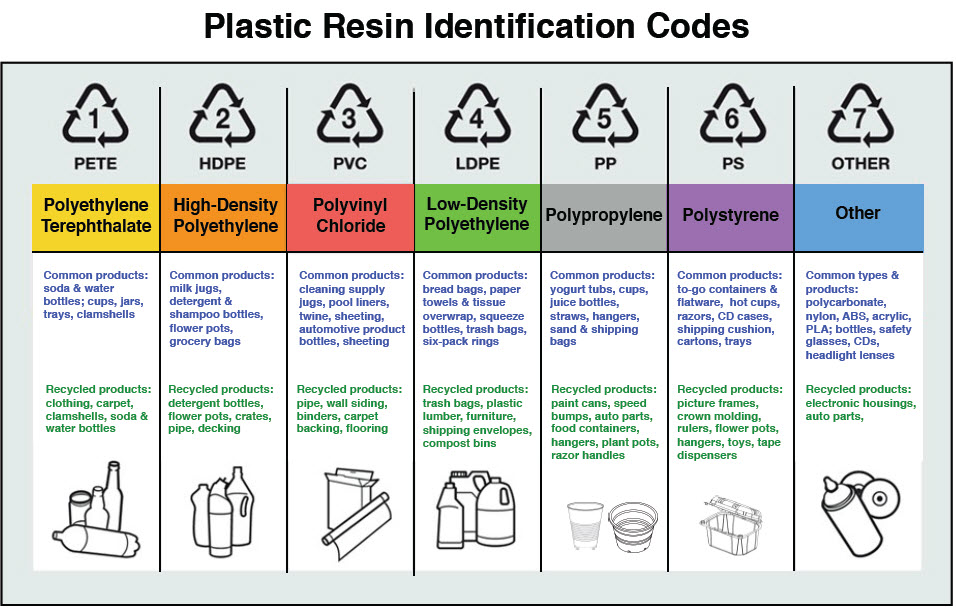
What’s a concerned citizen to do?  So many choices, so many ways to do the right thing.  Anthony Knight did some research for us, and has provided an easy-to-read and very clear article on information about recycling symbols on plastic items.  Read and learn, friends:

- Ruth Robinson (ACC Eco Group)


What Do Recycling Symbols on Plastics Mean?


Your guide to figuring out what those recycling codes on plastics mean. Also see How to Avoid Phthalates and Bisphenol A in Plastics


Number 1 Plastics
PET or PETE (polyethylene terephthalate)
 

Found in: Soft drink, water and beer bottles; mouthwash bottles; peanut butter containers; salad dressing and vegetable oil containers; ovenable food trays.


Recycling: Picked up through most curbside recycling programs.


Recycled into: Polar fleece, fiber, tote bags, furniture, carpet, paneling, straps, (occasionally) new containers

PET plastic is the most common for single-use bottled beverages, because it is inexpensive, lightweight and easy to recycle. It poses low risk of leaching breakdown products. Recycling rates remain relatively low (around 20%), though the material is in high demand by remanufacturers.

Plastic Recycling Symbol 2

HDPE (high density polyethylene)

Number 2 Plastics
 

Found in: Milk jugs, juice bottles; bleach, detergent and household cleaner bottles; shampoo bottles; some trash and shopping bags; motor oil bottles; butter and yogurt tubs; cereal box liners


Recycling: Picked up through most curbside recycling programs, although some allow only those containers with necks.


Recycled into: Laundry detergent bottles, oil bottles, pens, recycling containers, floor tile, drainage pipe, lumber, benches, doghouses, picnic tables, fencing

HDPE is a versatile plastic with many uses, especially for packaging. It carries low risk of leaching and is readily recyclable into many goods.

Plastic Recycling Symbol 3

Number 3 Plastics
V (Vinyl) or PVC

Found in: Window cleaner and detergent bottles, shampoo bottles, cooking oil bottles, clear food packaging, wire jacketing, medical equipment, siding, windows, piping


Recycling: Rarely recycled; accepted by some plastic lumber makers.

Recycled into: Decks, paneling, mudflaps, roadway gutters, flooring, cables, speed bumps, mats

PVC is tough and weathers well, so it is commonly used for piping, siding and similar applications. PVC contains chlorine, so its manufacture can release highly dangerous dioxins. If you must cook with PVC, don't let the plastic touch food. Also never burn PVC, because it releases toxins.

Plastic Recycling Symbol 4

Number 4 Plastics

LDPE (low density polyethylene)


Found in: Squeezable bottles; bread, frozen food, dry cleaning and shopping bags; tote bags; clothing; furniture; carpet

Recycling: LDPE is not often recycled through curbside programs, but some communities will accept it. Plastic shopping bags can be returned to many stores for recycling.

Recycled into: Trash can liners and cans, compost bins, shipping envelopes, paneling, lumber, landscaping ties, floor tile

LDPE is a flexible plastic with many applications. Historically it has not been accepted through most American curbside recycling programs, but more and more communities are starting to accept it.

Plastic Recycling Symbols 5

Number 5 Plastics
PP (polypropylene) 

Found in: Some yogurt containers, syrup bottles, ketchup bottles, caps, straws, medicine bottles

Recycling: Number 5 plastics can be recycled through some curbside programs.

Recycled into: Signal lights, battery cables, brooms, brushes, auto battery cases, ice scrapers, landscape borders, bicycle racks, rakes, bins, pallets, trays

Polypropylene has a high melting point, and so is often chosen for containers that must accept hot liquid. It is gradually becoming more accepted by recyclers.

Plastic Recycling Symbol 6

Number 6 Plastics
PS (polystyrene) 

Found in: Disposable plates and cups, meat trays, egg cartons, carry-out containers, aspirin bottles, compact disc cases


Recycling: Number 6 plastics can be recycled through some curbside programs.


Recycled into: Insulation, light switch plates, egg cartons, vents, rulers, foam packing, carry-out containers

Polystyrene can be made into rigid or foam products -- in the latter case it is popularly known as the trademark Styrofoam. Evidence suggests polystyrene can leach potential toxins into foods. The material was long on environmentalists' hit lists for dispersing widely across the landscape, and for being notoriously difficult to recycle. Most places still don't accept it, though it is gradually gaining traction.

Plastic Recycling Symbol 7

Number 7 Plastics
Miscellaneous

Found in: Three- and five-gallon water bottles, 'bullet-proof' materials, sunglasses, DVDs, iPod and computer cases, signs and displays, certain food containers, nylon

Recycling: Number 7 plastics have traditionally not been recycled, though some curbside programs now take them.

Recycled into: Plastic lumber, custom-made products

A wide variety of plastic resins that don't fit into the previous categories are lumped into number 7. A few are even made from plants (polyactide) and are compostable. Polycarbonate is number 7, and is the hard plastic that has parents worried these days, after studies have shown it can leach potential hormone disruptors.

Faith is a verb…. Musings by Pastor Tony June 16, 2017

Dear Friends:

I have just finished 2 days in a workshop setting for the Northern California-Nevada Conference Committee on Ministry. About 45 people, representing 3 different sections of the Committee, gathered to learn about each other’s work, to remind ourselves of the denominational policies that lead us in this work, and to think about the documents that guide ministers in their work.

The work of authorizing and supporting our clergy is guided by some documents, two of which are The Ordained Minister’s Code and the Marks for Effective Ministry. The Minister’s Code reminds us that we are in covenant not merely with our congregation but also with the wider church, and that we will work for just wages, not interfere with the ministry in places where we have previously served, complete regular educational requirements, and take care of ourselves and our families; we are held to account for the entire code. (To read the whole document, click here.)  The Marks for Effective Ministry are a list of 48 gifts that lead to excellence in ministry; no one is expected to hold all 48 gifts, and yet we expect ministers to be proficient in some from each of the 8 categories (to read it, click here). There is some overlap between the two documents (like membership in a local congregation, and taking care of one’s self). Together these documents guide us in our work of authorizing new ministers, supporting already authorized ministers, and calling to account our ministers in the UCC.

Section A, which I co-chair, works with ministers seeking authorization in our conference; Section B works with ministers who already hold standing in our conference, and Section E works with ministerial ethics violations and fitness reviews. (Sections C & D work with churches, and they were not present at this retreat.) Each of these sections is filled with dedicated, wise, and passionate folk who dearly love our denomination; we know our work is not just for this Conference, but on behalf of the entire United Church of Christ. We remind ourselves that our work with authorization and support of clergy is for the health of each congregation and setting of the United Church of Christ, and it can have lasting ramifications for decades.

While it may not be important to know everything about the Committee on Ministry, or the different sections, or even the Ministers Code and Marks for Effective Ministry, it is important for each UCC member to understand that our clergy are responsible to wider forms of the church, and that we take seriously the authorizing and support of our clergy. See you soon.

Peace, Pastor Tony

Pastor Tony's Sermon June 11, 2017

Genesis 1                    6-11-17            ACCUCC                      Rev. Tony Clark


“Ode to the Spirit”


The Holy Spirit,

who hovered over creation,

breathes, and blows and births relation.


Dry desert dust devils

and wet winter wind whirls,

sudden spring showers and

summer’s sun-flavored flowers

wind who whispers, willowy and warm,

calms the chaos and soothes the storms,

and when stasis sits, she inspires,

ignites desire,

fans flames of fire,

gives poetry to poets

sings symphony to sound

and activates artists all around.


Holy Wisdom, woman of wonder,

one of God, Divine and Feminine

Who tears asunder, with earthquake and thunder

and draws the plans for this world we live in.


This is what it looks like when dragonflies fly;

this is what it feels like when preachers prophesy;

this is what it sounds like when doves cry.

These the flavors of diversity,

these the dreams of destiny

these our primal passions, our visons and variety.


Instinct, intuition, butterflies in the gut,

that heart-pounding urge to suddenly speak out

goosebumps and grief

challenge and change,

emotions, and stress, and blessed relief.


Do we dare describe

the divine Spirit’s drive?

Visionary, vital, verdant, virile,

revision, revitalize, restore, restyle.


Come, Holy Spirt, inspire;

ignite us with your holy fire;

unite us with your living desire.

Impassion us with immodest,

imposing, immeasurable ideas;

drop dreams on our doorsteps

and visions into our veins

that we may dance, today,

the hopes of tomorrow;

that we may bring the kingdom to come;

that God’s justice on earth will be done;

and that you, the wonderful wind, whispering, willowy and warm

will come and calm our chaos and still our storms.


Spirit who hovered over creation

Breathe and blow and birth us in new relation.

Amen.

Faith is a Verb…. Musings by Pastor Tony June 9, 2017

In these weeks following Pentecost, the Holy Spirit is doing some new things, in the form of 0s and 1s, in our digital online presence. Have you noticed our new website? Jacob has created a nice new look; if you haven’t checked it out, click here to see it.

We chose the web address www.arlingtoncommunitychurchucc.org to replace the old www.acc-ucc.org, so that our actual name is reflected in the web address rather than just an abbreviation. While a bit long to type, this address allows people who are not “insiders” to more easily search for us. If you use a smart phone, the new site will come up formatted for the small screen (this is called mobile-optimized), where the old one came up as a shrunken version of the computer-screen-sized website, which was difficult to navigate on the smaller screen. Each week, we upload a written version of the sermon, and we link it to a SoundCloud file that allows people to listen to the sermon as well as read it. Check it out under the News tab from the home page. (If you’d like to listen to past sermons, check out our SoundCloud page here).

You will notice that our website is still under construction, and we could use your help!! We need photos to help us fill out our on-line presence. Whenever something happens at church take out your phone and shoot some pictures. Send them to Jacob at acc.staff@sbcglobal.net, or post directly on our Facebook page here.  If you are on Facebook, be sure to like us and make a comment about who we are. We are uploading sermons, events and other things of note from the UCC or the Conference to our Facebook page. If you like something on our page, go ahead and share the posts to your own timeline so we get more coverage. Please also post devotional pieces to the page.

And while you are at it, please drop a note to Jacob to let him know how much you appreciate his work!!

Who knew the Holy Spirit is fluent in 0s and 1s?  She is, and we are learning to be as well.

Peace, Pastor Tony

2017 ACC Kensington Animal Fair: Blessing of the Animals & Pet Adoptions

By Nina Harmon

Mark your calendar for Saturday, August 26th, 11am-2pm, at the Kensington Community Center, 59 Arlington Ave, Kensington for the Kensington Animal Fair. At 12 noon Pastor Tony Clark, M.Div., D.V.M., will offer a blessing of the animals for pets and owners.

The day will include demonstrations by Hazel Weiss and her service dog, K-9 Police Dogs, dog training, Friends of the Library, Dog Scouts of America, and a raffle. We'll have homeless cats, dogs, rabbits, guinea pigs, and birds needing adoption or fostering. Contra Costa County Animal Care and Control will provide low cost inoculations, micro-chipping, and registration with amnesty. Their veterinarian will talk with you about the best health care for your pet. Our local Girl and Boy Scouts will be selling snacks and beverages.

Along with the raffle, you'll have an opportunity to donate money to the rescue orgs.  Please send raffle items to the church, and checks made out to ACC or Arlington Community Church with Animal Fair on the memo line. All donations go to the rescue organizations - we will give you a donation letter for your tax deductions.

So bring your pets for a blessing, open your hearts to a homeless pet, and have a wonderful family day in the park.

 For more information see our link

www.arlingtoncommunitychurchucc.org/all-creatures.